02Work

Built, shipped, measured.

Split two ways: software that runs, and studies that produced a result. Newest first in each. Three smaller projects are listed at the end.


Shipped and running

Software that works end to end — a service, a package, an application.

AI Voice Testing Platform

An end-to-end platform that autonomously places outbound phone calls to a production AI healthcare receptionist and stress-tests it through multi-turn patient simulations. A Python orchestrator drives 10 scripted patient personas — appointment scheduling, medication refills, insurance questions, and deliberate edge cases like refusing to give a date of birth or interrupting the agent mid-sentence.

Each call runs an LLM as the patient brain with speech synthesis and transcription in the loop. When a call ends, a FastAPI webhook server captures the recording, transcript, and metadata to disk for review. I chose webhook capture over polling to keep results event-driven, and ran calls sequentially so failures stay isolated and debuggable.

Role: Sole developer — designed the persona scenarios, built the call orchestration and webhook capture pipeline, and wrote up the findings.
Outcome: Surfaced 7 reproducible defects, including a fabricated patient date of birth, a false promise of human escalation, and safety guidance truncated mid-sentence by an interruption. Also documented 2 verified correct behaviours where the agent properly refused out-of-scope medical advice.
  • Python
  • FastAPI
  • Vapi
  • LLM prompting
  • Speech-to-text
  • Voice synthesis
  • Webhooks

Human Segmentation from Images

A U-Net segmentation model in PyTorch that extracts human figures from photographs, trained on paired images and segmentation masks. I wrote the data loading and preprocessing from scratch rather than using a prebuilt dataset class, which meant handling image–mask alignment and augmentation myself — the part of segmentation work where most silent bugs live.

Role: Worked solo across the whole thing — the U-Net architecture, the custom PyTorch data loading, and the serving layer.
Outcome: Trained model weights committed to the repository and served behind a Flask application that returns a predicted mask for an uploaded image.

  • Python
  • PyTorch
  • U-Net
  • Image segmentation
  • Flask

database-mongodb

A Python package that automates MongoDB connections and database operations. I built it as a self-directed learning project to work the full Python packaging lifecycle end to end — local development, testing, CI/CD, then public distribution on PyPI.

Role: Sole owner and maintainer — package architecture, core functionality, the testing and CI/CD setup, and every release.
Outcome: 11 versions published to PyPI (v0.0.1 → v0.0.11); installable with pip install database-mongodb; verified by PyPI.

  • Python
  • MongoDB
  • setuptools
  • pyproject.toml
  • tox
  • pytest
  • GitHub Actions
  • PyPI

MCQ Generator — LangChain and OpenAI

A Streamlit application that turns an uploaded PDF or text file into multiple-choice questions. The user sets the question count, subject, and complexity; a LangChain pipeline generates the questions against the OpenAI API, then runs a second evaluation pass that grades the questions for relevance and difficulty rather than trusting the first generation.

Role: Built alone, start to finish — the generation and evaluation chains, the Streamlit interface, and packaging it as an installable module with logging.
Outcome: A working LLM application with a two-stage generate-then-evaluate pipeline, which is the pattern that keeps generated content usable.

  • Python
  • LangChain
  • OpenAI API
  • Streamlit
  • Prompt engineering

Studies and findings

Work whose output was a result rather than a running system.

The largest study isn't here. My M.S. thesis — a pipeline predicting E. coli drug resistance from bacterial genomes — has a page of its own.

Appliance Energy Consumption Prediction

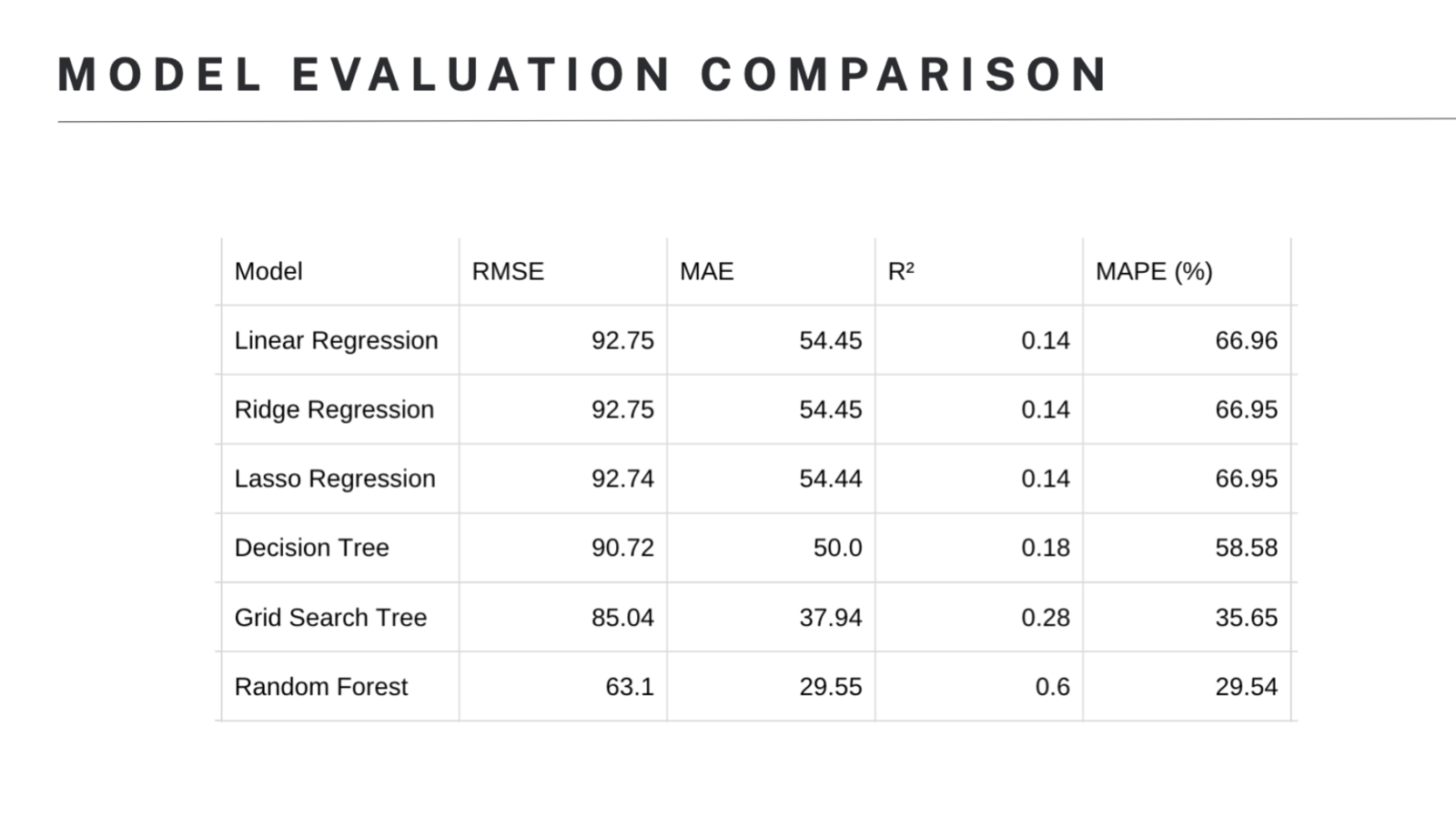
Forecasting hourly appliance energy usage for a Belgian household from environmental data recorded at 10-minute resolution. I built regression models — Random Forest, XGBoost, and LASSO — and showed that feature-rich models outperform pure time-series approaches on this data.

Model evaluation summary comparing the regression models trained on the appliance energy data
Model evaluation across the regression baselines and tuned tree ensembles.

Role: Sole contributor — built the data pipeline, feature engineering, and model benchmarking.
Outcome: Random Forest delivered the best performance (R² = 0.60, RMSE = 63.10); MAPE fell from 67% on the linear baseline to 30% with tuned tree ensembles.

  • Python
  • Jupyter
  • Pandas
  • Scikit-learn
  • ARIMA
  • Random Forest
  • XGBoost

Alzheimer's Disease Classification Using PET Images

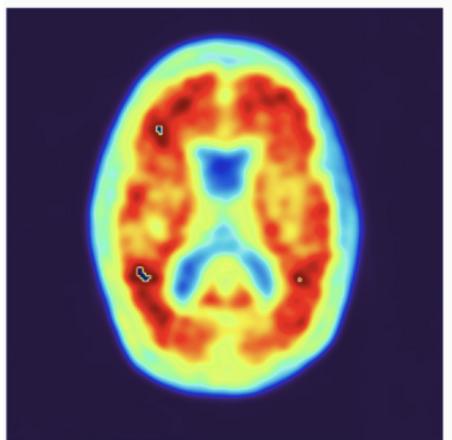
A group deep learning project comparing three transfer-learning architectures — VGG16, ResNet-50, and Inception V3 — on ADNI PET scans for 3-class cognitive stage classification (CN, EMCI, AD). I owned ADNI data access and the preprocessing pipeline, and built and tuned the ResNet-50 model while teammates implemented VGG16 and Inception V3.

Representative PET brain scan from the ADNI dataset used to classify cognitive stage
Representative PET scan of Alzheimer's disease, from the ADNI data used to train and evaluate the three architectures.

Role: Data lead and ResNet-50 implementation — obtained ADNI data access authorization, owned the preprocessing and augmentation pipeline, and built the ResNet-50 architecture.
Finding: The comparison surfaced a data problem rather than a winning model. ResNet-50 reached 99% validation accuracy but chance-level test accuracy, and Inception V3 hit 100% validation accuracy — the signature of data leakage between splits, not of a model that had learned the disease. I traced it to how the scans were partitioned and identified patient-level splitting, so that images from the same patient never straddle train and test, as the fix.

  • Python
  • TensorFlow/Keras
  • Transfer Learning
  • ADNI Dataset
  • ResNet-50

Also built

  • Classifying Text Formality from Abbreviation Use Evaluated logistic regression against random forest on whether abbreviations and their expansions distinguish formal from informal text. I was technical lead, with Baowi Li, Marisol Garcia, and Katrina Rascon.
    NLP · 2024
  • Shopping Trends & Customer Behavior Dashboard Interactive Dash web app over a 3,900-row Kaggle dataset. Modular Plotly components for product insight, seasonal trends, and US popularity heatmaps, with demographic filters and real-time interactivity. Frontend and data engineering, with Juvenal F. Barajas and Rustam Khamidov.
    CSC 805 · 2024
  • Educlouds — Full-Stack AI Entrepreneurship Platform A platform connecting PC owners with students who need compute. I contributed the Flask/SQLAlchemy backend services, authentication, and REST APIs for request management and resource tracking; the MVP was demonstrated at the CSC 890 capstone showcase. With Jules Bertrand.
    CSC 890 · 2024

Fundamentals

Algorithms written from scratch

Alongside project work I implement core machine learning routines without library shortcuts, on TensorTonic. 10 so far: linear, logistic, ridge and lasso regression derived and coded by hand, plus the numerical building blocks underneath them — cosine similarity, dot product, matrix transpose, the closed-form normal equation.

It is practice rather than a project, and it is here for one reason: knowing why ridge shrinks coefficients and lasso zeroes them is different from knowing which scikit-learn class to import.